


Product Description
Product Description
Your UAE Concrete Road Barrier Supplier for Safer Roads and Infrastructure.
One of the key factors that contribute to the success of any road and transportation network is safety. Whether on a high speed highway, a major infrastructure corridor, a construction site, an industrial facility, a commercial site or a residential roadway, the right barrier is the right solution to help control the movement of traffic, separate vehicles, protect work zones and enhance overall site safety.
With the ongoing development of roads, urbanization, and construction projects in the UAE, reliance on a trusted supplier of concrete road barriers is a must. The right supplier should be able to provide quality precast products, consistent dimensions, reliability in handling, project specific product configuration and documentation in terms of relevant consultant, authority and technical requirement.
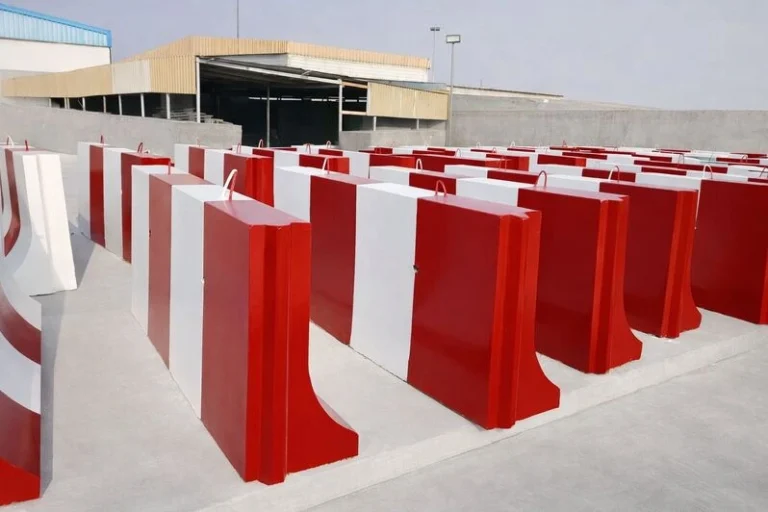
KKK precast service provides and produces precast concrete road barriers for road works, infrastructure, construction, traffic management, temporary diversions, perimeter, industrial facilities and any other project specific applications in the UAE.
We produce our concrete barrier solutions specifically to suit project requirements including barrier profile, dimensions, concrete grade, reinforcement, lifting, quantities and delivery sequence, consultant or authority requirements.
WHY CONCRETE ROAD BARRIERS MATTER
Concrete road barriers are not just designed to line the side of a road. Precast engineered elements used for traffic separation, work zone protection, vehicle guidance, perimeter control and selected infrastructure applications.
Concrete road barriers may provide several practical benefits as follows, depending on the design of the barriers and the needs of the project:
High Structural Strength: Precast concrete barriers offer considerable mass and structural strength in challenging roadway, construction and infrastructure applications.
Durability: Concrete barriers manufactured properly can provide satisfactory service under high temperatures, UV exposure, dust, challenging traffic conditions and specific coastal and industrial conditions.
Long Service Life: Concrete does not corrode in the same way as exposed steel barrier systems, but protection of the reinforcement, concrete cover and environmental exposure conditions must still be considered.
Quick installation: precast barriers can be pre-made and delivered to the construction site and then installed in order of the project.
Reusability: Temporary concrete barriers can be moved between phases of construction or projects if structural condition and project needs dictate.
Recyclability: At the end of the service life, acceptable concrete materials can be recycled for some suitable use, if required by local needs and permitted by the local waste-management system.
Finish Flexibility: Barriers can be manufactured or finished in various colours of paint, markers, reflectors and surface treatments as required by projects.
Precast concrete barriers are generally used in situations where mass, durability, stability and long-term performance are factors; steel and composite barrier systems are capable of being utilized for various applications.
TYPES OF CONCRETE ROAD BARRIERS
KKK Precast can provide various concrete barrier configurations as per client requirements.
Jersey Barriers
Precast concrete Jersey barriers are commonly used throughout the world for:
- Roadworks.
- Lane separation.
- Temporary traffic management.
- Construction zones.
- Traffic diversion.
- Vehicle guidance.
- Infrastructure projects.
K-Rail Barriers
K-rail barriers are designed to meet temporary traffic separation needs for projects and approved drawings and technical specifications.
Single-Sided Concrete Barriers
Single sided barriers can be chosen if there is a specific barrier orientation for traffic exposure, site conditions or project layouts.
Double-Sided Concrete Barriers
For central separation, traffic control and applications where vehicle traffic can happen on either side of the separation line, double-sided barrier profiles may be considered.
Interlocking Concrete Barriers
Male/female or other approved connecting methods can be employed in interlocking barriers for barrier alignment and continuity.
Temporary Concrete Barriers
Temporary barriers can be used for:
- Construction phases.
- Temporary road diversions.
- Work-zone protection.
- Site mobilisation.
- Temporary compounds.
- Perimeter separation.
- Urgent project requirements.
Special Concrete Road Barriers
Barriers can be produced to suit the needs of a project within the requirements of approved drawings, dimensions, reinforcement arrangements, connection systems, lifting details and technical requirements.
TYPICAL TECHNICAL RANGE
|
Specification |
Value / Description |
|
Product Type |
Concrete Road Barrier / Jersey Barrier / K-Rail Barrier |
|
Length |
Standard or Customised according to drawings. |
|
Height |
Project-specific |
|
Base Width |
Project-specific |
|
Grade of Concrete |
As per approved project specification |
|
Reinforcement |
Individualised reinforcement plan (specific to the project) |
|
Connection Type |
Male/Female Interlock or Project specific connection |
|
Handling |
Lifting eyes, lifting holes or approved lifting points |
|
Reflectors |
The project specifications will dictate the use of reflectors. |
|
Finish |
Off-shutter, painted or project specific finish |
|
Documentation |
Shop drawings and QA/QC package (as applicable) |
Final dimensions, unit weight, concrete grade, reinforcement and other connection and lifting information should always be checked against approved drawings and project specifications; the reflector configuration and performance are also to be checked against approved drawings and project specifications.
Concrete barriers are well suited for the climate in the UAE.
Road and infrastructure products are subjected to challenging conditions in the UAE.
Concrete road barriers can be subjected to:
- High temperatures.
- Strong UV exposure.
- Dust and sand.
- Heavy traffic.
- Construction activity.
- Industrial operations.
- Coastal environments.
- Saline exposure.
- Frequent relocation.
- Handling with crane and hiab.
- High-volume infrastructure programmes.
So, the choice of a barrier is not to be made by appearance or price.
Some key considerations could be:
- Traffic conditions.
- Vehicle exposure.
- Barrier application.
- Road geometry.
- Project duration.
- Environmental exposure.
- Concrete specification.
- Reinforcement requirements.
- Connection arrangement.
- Stability requirements.
- Lifting method.
- Consultant specifications.
- Authority requirements.
A temporary site barrier is not necessarily appropriate for a high speed road corridor. It is still critical to carry out project evaluation and to have approved specifications.
If you are considering concrete road barriers, it’s time to look for the right supplier.
There are a number of aspects to consider when assessing concrete road barrier suppliers in the UAE.
|
Criterion |
Why It Matters |
|
Project Compliance |
Supports compliance of barriers to technical and project needs |
|
Manufacturing Capability |
Is able to produce in a consistent manner for small, medium and bulk orders. |
|
Customisation |
Enables dimensions, profiles and details of the barrier to be customised to suit project requirements. |
|
Quality Control |
supports the consistency and dimensional accuracy of concrete, and the concrete quality traceability. |
|
Safe transportation, unloading and installation – Lifting Arrangements |
Important for safe transportation, unloading and installation |
|
Logistics Capability |
Helps coordinate delivery with the construction programme |
|
Documentation |
Meets consultant/authority/project QA/QC requirements |
|
Technical Coordination |
Assist with drawing, connection, handling and installation issues |
Efficient suppliers can easily explain the control of dimensions of barriers, reinforcement, the quality of concrete, lifting points, connections and documentation.
MANUFACTURING PROCESS
KKK Precast adopts a controlled precast production process which helps to ensure repeatability, quality control, dimensional consistency and project coordination.
A typical manufacturing process could consist of:
- Review of project drawings and specifications.
- Confirmation of type and dimensions of barriers.
- Re-check of concrete & reinforcement.
- Making of shop drawings as necessary.
- Mould preparation.
- Reinforcement fabrication.
- Reinforcement placement.
- Installation of connection items, lifting points.
- Pre-pour inspection.
- Concrete casting.
- Controlled curing.
- Demoulding.
- Dimensional inspection.
- Visual inspection.
- Testing and documentation of concrete.
- Planning for storage and delivery.
This controlled manufacturing process can ensure more consistency than the uncontrolled site casting, especially if a high number of repeated barrier units are needed.
QUALITY ASSURANCE & COMPLIANCE
Quality assurance is an important aspect of the manufacturing of concrete road barriers.
QA/QC activities could consist of:
Concrete Testing: Concrete test records and cube test results as per approved quality plan.
Dimensional Inspection: Checking barrier length, height, base width, profile and connection details.
Reinforcement Inspection: Inspection of Reinf. previous to casting of concrete.
Embedded Item Inspection: Lifting point verification, connection items verification and other embedded components verification.
Visual Inspection: Inspection of completed barriers for significant defects, damage, honeycombing and surface irregularities.
Production Traceability: Production records according to project identification and QA/QC needs.
Shop Drawing Control: Production in accordance with approved project drawings (if applicable).
Final testing and certification and documentation requirements will vary based upon project specifications, consultant requirements, authority requirements and approved submittals.
The RTA, Municipality, Authority and Consultant Requirements are outlined below.The RTA, Municipality, Authority and Consultant Requirements are detailed as follows:
Depending on location and the scope of the road and infrastructure project in the UAE, there may be different technical and documentation requirements.
These can include needs from:
- RTA.
- Municipalities.
- Project consultants.
- Developers.
- Main contractors.
- Infrastructure authorities.
- Project-specific technical specifications.
If available, barrier profile, dimensions, reinforcement, finish, reflector arrangement, connection and planning for delivery and quality assurance/quality control can be coordinated with the approved project requirements.
Always verify the compliance of the product for a particular project, not just the description.
APPLICATIONS IN THE UAE
Road barriers for concrete are suitable for various projects in the UAE.
Highway and Road Projects” is the title of the document.
Barrier systems for:
- Road diversions.
- Lane separation.
- Construction zones.
- Temporary traffic arrangements.
- Phased roadworks.
- Infrastructure upgrades.
Construction Work Zones
Physical barriers between construction and operating roadways.
Traffic Management
Temporary or semi-permanent barrier lines for controlled traffic movement / vehicle guidance.
Infrastructure Projects
Concrete barriers for large-scale infrastructure projects, utilities and project specific roads.
Industrial Facilities
Barrier solutions for:
- Factories.
- Warehouses.
- Service yards.
- Logistics facilities.
- Operational areas.
- Controlled vehicle routes.
Site Security
For selected perimeter control and access-management applications, heavy concrete barrier lines are provided.
Temporary Compounds
Barrier systems for:
- Construction camps.
- Staging areas.
- Storage yards.
- Temporary project facilities.
- Controlled work zones.
Edge Protection
Selected applications around:
- Industrial yards.
- Quarry roads.
- Drop-off zones.
- Controlled vehicle areas.
Always final suitability shall be determined by approved engineering and project requirements.
INSTALLATION & PROJECT HANDLING
It is essential that the concrete barrier is installed correctly, even if it is a good one.
Common concerns with project management are:
Site Review
Verify access, barrier alignment, installation sequence and unloading requirements.
Delivery Planning
Lead the coordination of transport based on:
- Quantity.
- Unit weight.
- Barrier dimensions.
- Site access.
- Delivery windows.
- Project sequence.
Barrier Placement
Mark units on approved drawings and site.
Alignment
Check the barrier line, spacing and connection arrangement.
Connection
Use interlocking or connection arrangements for projects as necessary.
Final Inspection
Verify:
- Alignment.
- Stability.
- Connections.
- Visible damage.
- Reflectors.
- Project-specific requirements.
Installation requirements can be very different from one barrier to another and can be dependent upon the road condition, traffic exposure and the barrier engineering requirements.
MAINTENANCE & INSPECTION
Concrete road barriers should be checked on a project-by-project basis and as deemed necessary by the road’s operation.
The following are examples of the types of things that might be considered during the inspection:
- Visible cracking.
- Impact damage.
- Barrier displacement.
- Connection condition.
- Reflector condition.
- Surface damage.
- Lifting point condition.
- Alignment.
- Debris accumulation.
- Damage due to construction equipment.
Following a substantial impact with a vehicle, broken barrier units should be checked prior to further use.
Option to deliver anywhere in the UAE.
KKK Precast is able to coordinate concrete road barrier supply and delivery throughout:
- Dubai.
- Abu Dhabi.
- Sharjah.
- Ajman.
- Ras Al Khaimah.
- Fujairah.
- Umm Al Quwain.
Planning for delivery is based on:
- Project location.
- Required quantities.
- Barrier dimensions.
- Unit weights.
- Transport requirements.
- Site access.
- Unloading arrangements.
- Availability of cranes or Hiab.
- Required delivery dates.
- Installation sequence.
Barriers can be delivered by project zones, priorities and installation requirements for large/phased projects.
What makes KKK PRECAST so special?
Concrete barriers can be produced based on drawings, dimension and technical specifications called for by Project Based Manufacturing.
Customisation Capability: Standard barrier configuration and project-specific barrier configuration are considered.
Controlled Precast Production: Factory production provides consistency and dimensional control and quality traceability.
Bulk Production Capability: for large volume and phased production requirements, production planning can be coordinated.
Lifting and Handling Coordination: Lifting points and/or handling arrangements can be planned based on project needs.
UAE-Wide Delivery: Planning for transporting and delivering goods can be done on a UAE-wide basis.
QA/QC Support: Production and quality relevant documentation agreed to project requirements can be prepared.
Coordinated Precast Packages: Concrete road barriers can be supplied with concrete Jersey barriers, T-walls, precast bunkers, concrete shelters, precast manholes, utility chambers and foundation blocks depending upon the project scope.
SURVEY FOR QUOTES:The following is essential to send for a quotation:
To get a concrete road barrier quote, please give us:
- Project drawings.
- BOQ.
- Required barrier type.
- Required barrier dimensions.
- Required quantities.
- Concrete grade.
- Reinforcement requirements.
- Connection requirements.
- Reflector requirements.
- The type of paint or finish to be used.
- Lifting requirements.
- Delivery location.
- Required delivery dates.
- Site access information.
- Unloading requirements.
- Crane or Hiab requirements.
- Installation sequence.
- As required by RTA.
- As per Municipality requirements if applicable.
- Consultant specifications.
- Authority requirements.
- Other technical requirements as relevant to the project.
These details will be used by our team to evaluate the project requirements and create an accurate quotation, please submit these details via our Contact Us page.
The dimensions of the final barriers, unit weight, concrete grade, reinforcement arrangement, connection system, lifting details, stability requirements, finishes, configuration and performance criteria of reflectors are all subject to approved drawings, engineering design, consultant requirements, authority requirements and project specifications.